Areas Within Asia to Avoid: Understanding Realities Over Fear
Welcome! We are CamHong and Paul. Every corner of the globe has places that demand caution—whether it is a troubled nation, an isolated border district, or a single neighborhood in the city you call home. Millions visit Disneyland while higher-crime neighborhoods lie 30 miles away in Los Angeles; 25 million tourists explore Washington, D.C., every year despite localized elevated crime rates. Understanding Asia’s geography and micro-locations unlocks confident, safe, and enriching travel.
1. Comparative Crime Statistics: U.S. vs. Asian Travel Hubs
Examining hard numbers dispels generalized anxiety. While petty property crimes exist worldwide, violent crime in stable Asian destinations remains significantly lower than North American averages.
Crime Metrics per 100,000 Population (Estimated Baseline)
| Crime Category | U.S. Rate (per 100k) | Asian Hubs (per 100k) | Primary Factors & Practical Notes |
|---|---|---|---|
| Violent Crime | ~380.0 | ~45.0 | Mass armed violence is virtually absent in major hubs due to strict firearms laws. |
| Criminal Homicides | ~5.7 | ~1.2 | Homicide rates in Japan (~0.2) and Southeast Asian hubs remain far below U.S. medians. |
| Sexual Assault | ~42.5 | ~3.8 | High social policing and deterrent legal sentencing across key tourist corridors. |
| Drug-Related Offenses | ~340.0 | ~52.0 | Severe statutory penalties minimize public gang and open street narcotics distribution. |
| Petty / Opportunistic Theft | ~180.0 | ~165.0 | Motorbike grab-and-go thefts and market pickpocketing represent the primary traveler risk. |
2. Specific Areas to Avoid vs. Surrounding Safe Havens
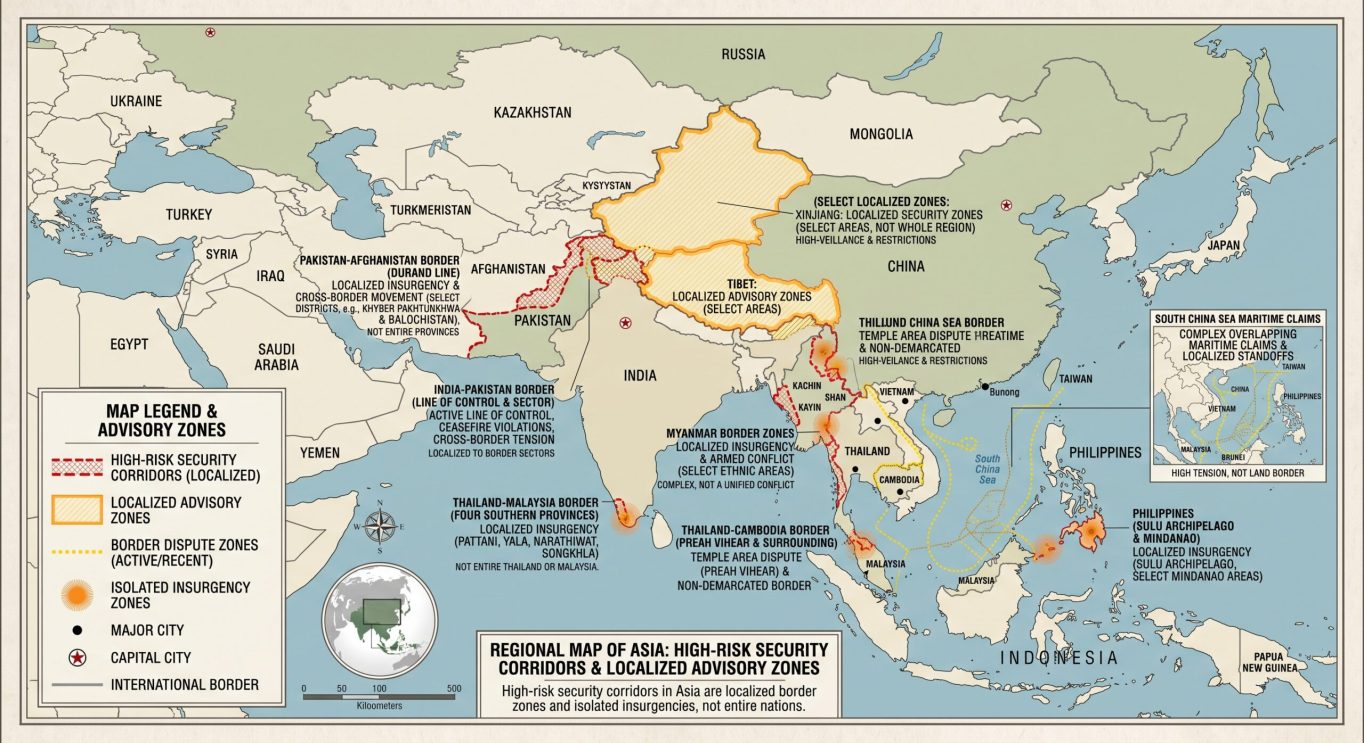
Writing off an entire country because of a border skirmish or isolated insurgency is equivalent to canceling a trip to the Grand Canyon due to street crime in Chicago. Here is the micro-geography retirees need to know:

Thailand: Deep South Border vs. Central Havens
Avoid: Yala, Pattani, Narathiwat, and southern Songkhla due to periodic ethno-nationalist insurgent violence.
Safe & Thriving: Bangkok, Chiang Mai, Hua Hin, and Phuket sit hundreds of miles away and operate as premier global retirement havens. [1]

Myanmar: The US State Department and the Australian Smartraveller
Avoid: Widespread fighting between military regime and opposition forces with random curfews and arbitrary arrests.
Safe & DO NOT TRAVEL: Burma, one time backpacker destination, now on a global Do Not Travel ban. [1]

Philippines: Sulu Archipelago vs. The Visayas
Avoid: Western Mindanao, Basilan, and the Sulu Archipelago due to historic maritime piracy and militant splinter cells.
Safe & Thriving: Cebu, Bohol, Dumaguete, and Palawan remain exceptionally peaceful island havens with deep English fluency and welcoming communities. [2]
3. Department of State & Global Travel Advisories
International advisories categorize risk on tiered scales. Understanding the distinction between countrywide alerts and localized warnings prevents unnecessary itinerary cancellations.
Level 1: Normal Precautions
Nations: Japan, Singapore, Malaysia, Vietnam, Taiwan, South Korea.
These destinations represent some of the safest travel environments globally, with violent crime rates far lower than Western metropolitan cities.
Level 2: Exercise Increased Caution
Nations: Thailand, Philippines, Indonesia, India.
Issued primarily due to localized regional conditions (e.g., specific southern provinces or active volcanic zones), not generalized danger in expat centers.
Level 4: Do Not Travel
Nations: Myanmar, North Korea, Afghanistan, Yemen, Syria.
Nationwide armed conflict, civil unrest, or arbitrary detention risks necessitate complete avoidance for non-official travel.
4. Healthcare, Geopolitics & Everyday Risk Management
When traveling or retiring past 50, “safety” encompasses healthcare accessibility, economic buffers, and day-to-day transit logistics just as much as crime statistics.
JCI-Accredited Healthcare
Major hubs like Bangkok (Bumrungrad, Bangkok Hospital) and Kuala Lumpur provide world-class medical facilities with English-speaking specialists at a fraction of U.S. out-of-pocket costs.
The True Daily Hazard: Traffic
Expats consistently report that motorbike congestion and pedestrian crossings represent a greater tangible danger than street crime. Utilize licensed ride-hailing apps (Grab) and rail transit.
Economic Predictability
A lower cost of living allows retirees to maintain comfortable emergency funds, live in managed condominiums with 24/7 security, and preserve financial independence.
CamHong & Paul’s Final Take: Know Before You Go
Don’t let blanket fears keep you from experiencing the warmth of hiếu kháchHeartfelt hospitality or the relaxed pacing of sabai sabaiComfortable, easygoing lifestyle. Educate yourself on specific provinces, respect local laws, keep your belongings secure in crowded markets, and enjoy the rich cultural tapestry Asia has to offer.